How “Asian Cuisine” Became Berlin Cuisine: Berlin’s Changing Food Scene
I grew up in Cape Town in the late nineties, surrounded by an extraordinary mix of cultures and cuisines.
For my family, that meant getting spices from the Indian aunty down the road who knew exactly what you needed, eating chicken liver peri-peri to make your eyes water at a Portuguese-Mozambican kiosk, or driving across town to a Chinese restaurant that looked more like a school hall from the seventies.
The owner had her own approach to hospitality. She would appear at our table, study each of us suspiciously and announce: “You are having that. You get this. And you, young man, get the Sweet and Sour Chicken.” Then she’d disappear into the depths of the kitchen. Apparently ordering wasn’t necessary here — she knew best.
And, of course, she was always right.
That was the Cape Town I grew up in: African, Malay, Indonesian, Indian, Chinese, Thai, Arab, Japanese, Portuguese and other European influences, to name a few — all mixing it up in one vibrant city.
Decades later, Berlin still gives me that same excitement — and perhaps also explains my slightly burnt palate.
Berlin and Cape Town don’t necessarily have particularly much in common. But here in Berlin, food does something that reminds me of Cape Town: what once seemed “foreign” or “exotic” eventually becomes a completely normal part of everyday life.
They simply become regular places where we eat.
Vietnamese food is perhaps the best example. Pho with work colleagues at lunch, bánh mì on the go or noodles after work no longer particularly feels like an excursion into another cuisine. The same applies to Korean, Thai and Japanese food. These restaurants have simply become part of the city: neighbourhood places, lunch spots, somewhere reliable around the corner. Their influence is so embedded that Berlin Food Week’s Alexandra Laubrinus made the deliberately provocative suggestion that “the real Berlin cuisine is perhaps Vietnamese.”
There is, of course, a much longer history behind that. Berlin’s Vietnamese community has been part of shaping the city for decades — through restaurants, shops, trade and places such as the Dong Xuan Center. The Vietnamese food culture that now feels so much a part of everyday Berlin has grown over generations. It isn’t some new restaurant trend.
What really interests me is: what happens after that? Once a food culture has arrived in a city, established itself and simply become part of it.
From “Asian” to Isaan, Sichuan and Zigong
“Asian food” is sometimes still convenient shorthand. But the closer you look at Berlin’s food scene, the less the term tells us about what is actually happening. It gets interesting when things become more specific: Thai becomes Isaan or southern Thai. Chinese becomes Sichuan — and Sichuan becomes the cooking of Zigong.
At the same time — and this is what I find particularly exciting — chefs and restaurateurs whose own lives cross several cultures are increasingly less interested in defining which one their restaurant is supposed to represent.
At Fukagawa Ramen, Leonardo Tsubasa Donati draws on his Japanese and Italian-German roots. And at their new Fukagawa fine-dining restaurant on Fichtestraße, he’s mixing things up even further, working alongside chef Felix Thoms to reinterpret the flavours and traditions of Japanese ramen through classical French technique.
In Friedrichshain, Gaan Kitkoson’s Khao Taan grew from pop-ups and street-food markets into a restaurant centred on the family-style Thai eating he knew from his grandmother.
And then I’ll walk through Prenzlauer Berg on a lazy Saturday morning and end up at Kape de Filipina, a Filipino specialty coffee shop serving single-origin coffees from regions I’d never heard of before: Mindanao, Mount Apo and Cavite. That makes me genuinely happy. Not because it feels exotic, but exactly because it doesn’t.
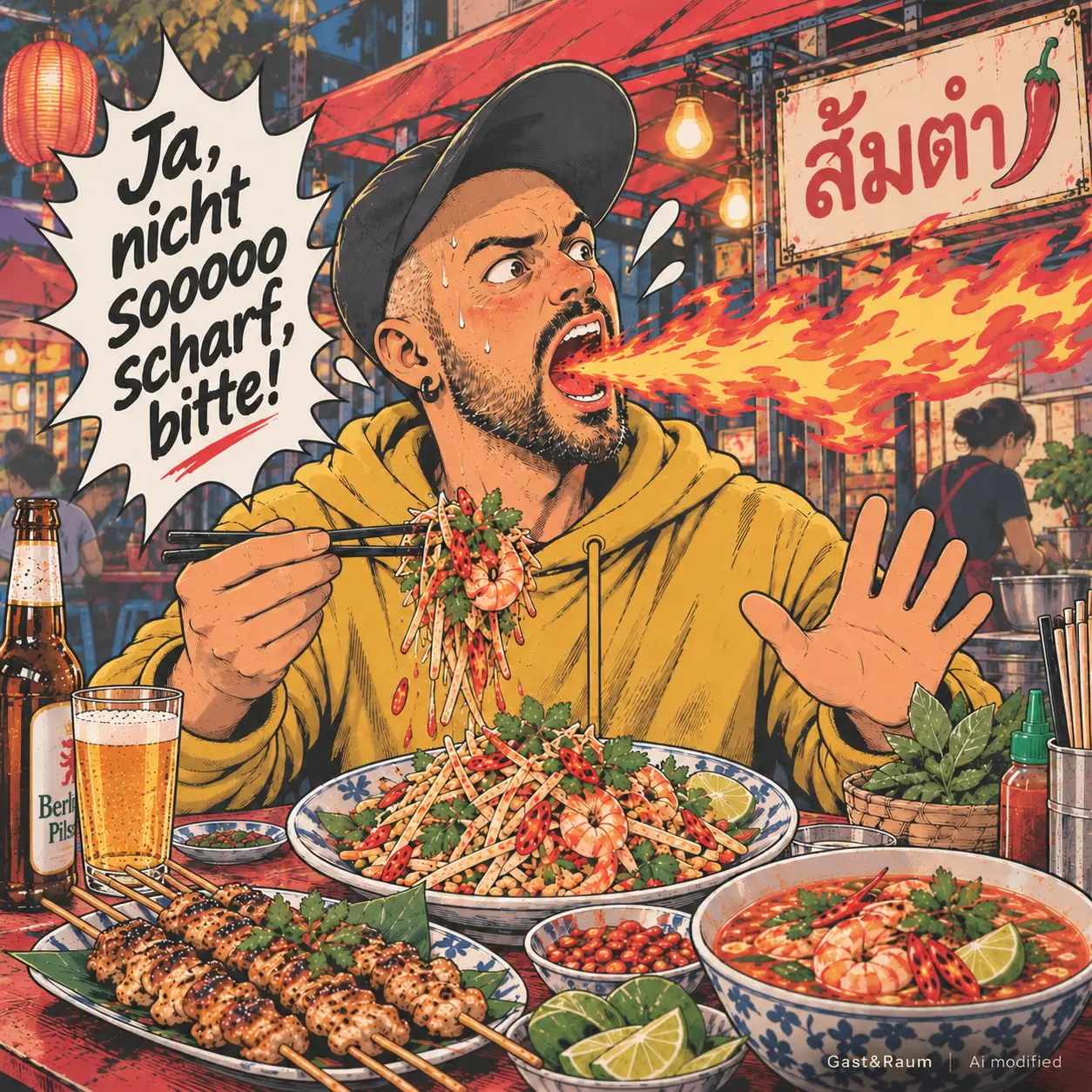
For me, this isn’t about so-called fusion. I increasingly find that word a little too easy. What interests me is freedom: to cook from childhood memories and family traditions, from places you have lived or travelled, from techniques learned in another kitchen and from the city you happen to call home now. All of those influences can end up in the same restaurant without needing to become a marketing category.
You can see versions of this elsewhere in the world too. Lima, Peru, is perhaps one of the most fascinating examples. Generations of Japanese migration helped shape Nikkei cooking, while Chinese migration created chifa. Today both are completely woven into Peruvian food culture rather than sitting outside it as something foreign.
And this movement is taking different forms around the world. The Michelin Guide describes the continued growth of East and Southeast Asian cuisines as one of the trends shaping London in 2026. Copenhagen talks about a “new Asian wave”, while in the Netherlands a new generation of Indonesian and Indo-Dutch chefs is revisiting regional traditions and a culinary identity deeply entwined with the country’s colonial history.
Good gastronomy is becoming more specific about where it comes from while becoming less concerned about where it is supposedly allowed to belong.
Berlin, with its many international communities, creative restlessness and constant appetite for reinvention, feels like a city made for exactly this kind of evolution.
Maybe all of this started for me back in Cape Town — as a pimply kid on the beach, happily devouring a plate of langoustines with lemon-garlic butter straight off the braai.
Food taught me early that cultures don’t stay within the boundaries we create around them. Recipes travel, generations reinterpret them, ideas evolve — and eventually something that once came from somewhere else simply becomes part of your own Kiez.
This article is for informational and marketing purposes only and may include the author’s personal views and opinions. While every effort has been made to ensure accuracy, no guarantee is given as to the completeness, accuracy or timeliness of the information provided. External links are provided for further information; responsibility for the content of linked websites lies solely with their respective operators. This article does not constitute legal, tax, financial or business advice. Before making important decisions, readers should seek appropriate professional advice and conduct their own due diligence.

